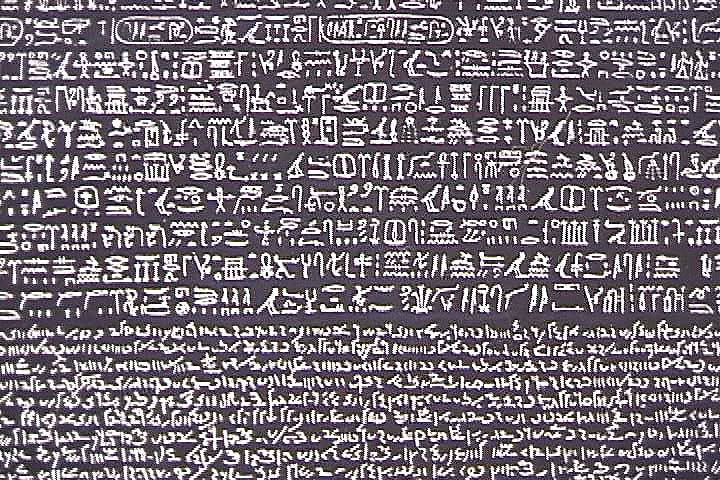
18 - Introduction to new translation of Rosetta Stone
From the Land of Egypt
Ossama Alsaadawi declares the following historical introduction to new translation of the Hieroglyphic Text of Rosetta Stone.
Introduction to new translation of the Hieroglyphic text of Rosetta Stone
I- Preface:
I.1- This historical translation is to be posted on the Guardian Bulletin Board
sponsored by Mr. Andrew Bayuk,
Hieroglyphic section, on Saturday; January 1st, 2000 AD
It comes due to a friendly request from some respected savants to inspect an alternate translation of Rosetta Stone in light of Ossama Alsaadawi's theory on Egyptian Hieroglyphs.
I.2- Rosetta Stone was made, in Egypt in year 196 BC, of basalt stone. Its present dimensions are nearly 118 cm-H, 77 cm-W and 30cm-D. It is now settled in The British Museum. Also, a well-made copy of it is presented by The British Museum to, The New Great Library of Alexandria.
I.3- Rosetta Stone "RS" includes three independent texts written in three different lines:
* Hieroglyphic line, upper text.
* Demotic line, middle text.
* Greek line, lower text.
I am concerned only with Hieroglyphic text.
I.4- One can observe the following remarks:
* It is composed of 14 non-complete Hieroglyphic lines.
* The writing direction is from right to left.
* The lines are formed in a nearly triangular shape due to stone breaking.
* 6th line contains three cartouches, 12th line contains one cartouche and 14th line contains one cartouche.
I.5- Legend:
I shall use the following notions as a convention for detecting tones of certain Hieroglyphic signs that have no equal phones in English language:

Numeric symbol [7], or capital [H] will be used to indicate Hieroglyphic sign [V28], the wick, which has the phone - h'. That means [7] or [H] will be pronounced as h', which is a magnified guttural (h)

Numeric symbol [3] will be used to replace Hieroglyphic sign [D36], the arm, which has the phone of (3ayn) - a'.

Numeric symbol [2] will be used to replace Hieroglyphic sign [G1], the vulture, which has the phone of - a, like first sound of word "apple", at any position within one word.
II- Introduction:
The Hieroglyphic text of Rosetta Stone is divided into two parts, separated by one very important shorthanded word, which is:

It is exactly equivalent to the famous Dtt word, and has the near meaning:
* those were verses from the eternal divine book *
this word is placed nearly in the middle of the 10th line of RS
Each section has an independent idea that we shall explain them in some detail in the following sections:
III- Part 1
by: Ossama Alsaadawi
III.1- The main idea of the text:
Part-1 of the Hieroglyphic text written in Rosetta Stone is mainly a divine spiritual "forecast" that speaks about some specified sacred great character that will come sometime in far future, "on the land of Egypt", to reestablish, reconfirm and re-maintain Ancient Egyptian religious beliefs and rituals.
The forecast is styled in form of some religious and spiritual calls and invocations.
This ultra important divine forecast summarizes and incorporates the whole Ancient Egyptian Religion, which is mainly peaceful creed of Abraham
This fact is definitely proved in the cartouche embedded in RS text known wrongly as 'Ptolmis' cartouche, which includes the following very important expression:

this famous frequent AE word reads 'ftaH-mri', which exclusively means:
* then follow the peaceful creed of Abraham *
Egyptologists offered this word the meaning of 'beloved of PtaH' !!

Another decisive conformation to this fact comes from just the preceding Dtt word, which means that primary text of this basic cartouche is not a name at all, but in fact it is an obvious religious text that is chosen carefully. The whole cartouche may refer to rule period of a specified Greek king.
That pre-promised divine character has been described by some Hieroglyphic symbols, words and indications that have some common meanings such as:
the selected, the chosen - the dispatched - word of God - the supported - light - mercy to all nations
the mediator, intercessor - of praised status - herald - witness - preacher - Warner
etc, etc
example

III.2- Apparent reading:
Apparent reading of AE words leads to phonetically distorted and meaningless readings and translations, either for texts or names. AE's used to pluck off certain letters or signs out of their Hieroglyphic words according to some conventional rule that they kept secret for some reasons which are beyond our research work here. On the other hand, to reach true meanings of words and expressions one should extract precise phonetic values of those words and expressions. For that reason Egyptian Hieroglyphic written language is a very difficult one. Hence, any slight mistake in translating or detecting up phonetic values of Hieroglyphic signs, letters or symbols will lead to disastrous results, giving completely different meanings of translated texts.
Moreover, current Egyptian slang language should be studied carefully in order to recognize Egyptian expressions easily. My in-depth studies proved that Egyptian "oral" language has not basically changed since far pre-dynastic eras, because those words and expressions are based on spiritual and religious bases, and are still used among Egyptian peoples literally up today.
to be followed:
Ossama Alsaadawi