6 - Ancient Egyptian Calendar
Ancient Egyptian Calendar
This page presents Dr. Ossama Al-Saadawi's research on the Ancient Egyptian Calendar, outlining his interpretation of its structure, calculation method, astronomical foundations, and timekeeping system. It also explores the division of the year, months, weekdays, and seasons, and includes illustrative images, tables, examples related to Ancient Egyptian festivals and celebrations, as well as the English version of the study.
Notes From Ossama Alsaadawi
AE Calendar deciphered by Ossama Alsaadawi: (Posted On 12/5/2002)
:
This chapter is introduced here according to the demand of:
Mr. Roger Fylling - Sweden
rfy@malmo.bonet.se
--------------------------------------------
**Ancient Egyptian Calendar System**
**A new scientific breakthrough in light of a new theory**
_Deciphered By, Ossama Alsaadawi_
Many peoples allover the world is really interested in first ancient civilization known to mankind in history. It is the Ancient Egyptian Civilization.
Fortunately, Ancient Egyptians left behind them thousands of lingual texts written in Hieroglyphs, or Hieroglyphic line, in many different forms such as mural texts, papyrus texts, coffin texts, pyramid texts, shrine texts, books of the dead, grave texts, cartouche texts and many others. Hieroglyphs and Hieroglyphic writings were extremely stable for thousands of years starting from far pre-dynastic times up to year 390 AD. It is clear that the AE's were mastering this kind of writing and used it fluently to express their extremely stable Egyptian spoken language.
These vast amounts of AE texts imply at once that if we might really be able to translate these texts Truly then we can know for sure what was going on in that very ancient world. One application for the True reading of Hieroglyphs is the Miracle of deciphering Ancient Egyptian Calendar System.
Ancient Egyptian Calendar System:
No doubt, Ancient Egyptians used a highly accurate and sophisticated Calendar System. They were keen to keep its calculation techniques highly confidential for not to be stolen by other coeval states. However, when Ancient Egyptian advanced civilization started to collapse nearly 1000 years BC, many other states allover the world tried to imitate and transcribe their highly advanced calendar system. Unfortunately, all their efforts failed to discover the True Ancient Egyptian Calendar System. Consequently, current universal calendar systems passed through many historical modifications but ALL of them still encounter obvious mistakes that should be rectified every few centuries!
On the other hand, we find that Ancient Egyptians recorded and reported technical details of their unique calendar system within their Hieroglyphic texts, but Egyptologists failed to read it properly because most of Hieroglyphs have been wrongly deciphered in light of traditional theory of Champollion.
Here I have the honor to introduce this historical research work, in which Ancient Egyptian advanced calendar system has been restored after nearly 3000 years of absolute forfeiture. This comes due to correct reading of Hieroglyphs in light of Alsaadawi’s Theory of True Hieroglyphs.
Calendar:
Ancient Egyptians used a unique highly accurate calendar system that accumulates no error, even if just one second, with pass of time along hundreds or even thousands of years. This calendar system has the following features:
1 = It is a three dimensional orthogonal Astro timing system.
2 = It uses compound mutual real motion of both sun and moon as time measurement referenced to Astro ecliptic time events.
3 = It uses 13-month, 7-day a week system.
4 = First 12 months have fixed time span of 28 days.
5 = 13th last month has variable time span, but having an integer number of weeks. They called this 13th month 'the sacred month', during which main AE religious rituals have been celebrated. They marked this period by a 4-fingered palm to indicate that this period is sanctified and no human fights are allowed within.
6 = Egyptian year starts always on Sunday, (day No.1) of the week, which counts also as (day No.1) of the new-year.
7 = Egyptian year starts always on the day of Egyptian Easter.
8 = Egyptian year starts always referenced to a fixed Astro event, which is the vernal (spring) equinox day.
9 = Equinox day is appointed by a simple shadow measurement.
10 = Egyptian year has:
+ Minimum of 336 days.
++ Maximum of 385 days.
Which, inclusively include,
+++ 354 annual lunar days
++++ 365 annual solar days.
These four parameters are averaged to 'exact' 360 True Astro Days, which forms a Perfect Astro Circle.
11 = Ancient Egyptian True Day is nearly 0.98 of our current falsified apparent day.
12 = AE True Day is divided to 24 hours.
13 = AE Hour is divided to 4 quadrants, each divided to 90 sections to give a total of 360 sections (moments) per one hour, or (4x9x10) = (36X10). Therefore, one (moment) of the hour corresponds to, or matches, one True day of the Astro year.
14 = Smallest AE time unit is called (blink) !!
15 = AE year has 3 seasons, nearly Astro fixed:
+ Harvest season >> (shamw)
++ Spring season >> (rabee3)
+++ Winter season >> (shitaa2)
Each season extends for 4 months, 28 days a month. Harvest season starts with first day of new-year, known as (Shamw) day.
16 = Week days are named as follows:
**The following day names of the AE week are taken from both Egyptian and Coptic etymologies**
Sunday >> (Hadd)
Monday >> (itnain)
Tuesday >> (talaat)
Wednesday >> (arba3)
Thursday >> (khamees)
Friday >> gom3a
Saturday >> sabt
17 = Names of the 13 months:
The following seasonal month names are taken from both Hieroglyphic and Hieratic records, please see:
*Bagheyat_Altalebien_page23_in Arabic_By_Ahmad_Bek_Kamal*
*Vise director of Egyptian Museum in year 1909*
M1 >> shahr awwal (1)
M2 >> shahr taani (2)
M3 >> shahr taalit (3)
M4 >> shahr raabi3 (4)
M5 >> fiTr awwal (1)
M6 >> fiTr taani (2)
M7 >> fiTr taalit (3)
M8 >> fiTr raabi3 (4)
M9 >> shitaa2 awwal (1)
M10 >> shitaa2 taani (2)
M11 >> shitaa2 taalit (3)
M12 >> shitaa2 raabi3 (4)
M13 >> Hr / alHaraam
18 = the Ancient Egyptian calendar works as follows:
a = Appoint vernal equinox day.
b = Watch for first following full moon.
c = Leave first Sunday, (to avoid any ambiguity).
d = Second Sunday after full moon is the Egyptian Easter. It's also first day of the new-year, also first day of first week.
e = Count 12 months, each 4 weeks or 28 days with a total period of 336 days / 48 weeks.
f = 13th month starts at beginning of 49th week and continues with an integer number of weeks (-3-4-5-..-weeks) up to next Easter day, which must be (Sunday).
g = The cycle repeats.
..
..
Ossama Alsaadawi
--------------------------------------------------------------------------------------------------------------------
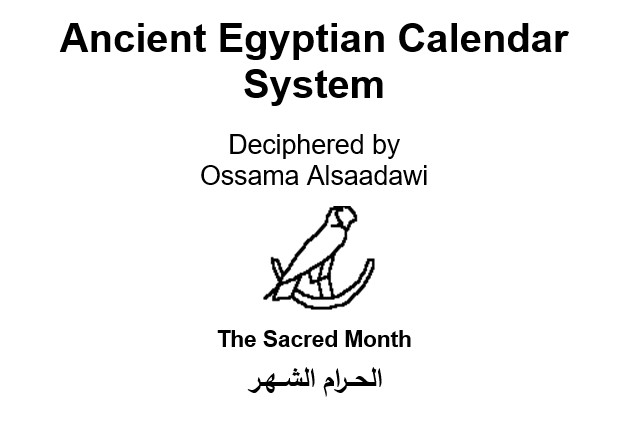
Ancient Egyptian Calendar System
Deciphered by
Ossama Alsaadawi

The Sacred Month
الشــهـر الحــرام
Ancient Egyptian advanced calendar system has been restored after nearly 3000 years of absolute forfeiture, due to correct reading of Hieroglyphs in light of Alsaadawi's Theory of True Hieroglyphs.
Ancient Egyptians used a unique highly accurate calendar system that accumulates no error, even if just one second, with pass of time along hundreds or even thousands of years. This calendar system has the following features :
1=
It uses compound mutual real motion of both sun and moon as a time reference and time measurement.
2=
It uses 13-month, 7-day a week system.
3=
First 12 months have fixed time span of 28 days.
4=
13th last month has variable time span, but having an integer number of weeks. They called this 13th month 'the sacred month', during which main AE religious rituals have been celebrated. They marked this period by a 4-fingered palm to indicate that this period is sanctified and no human fights are allowed within.
5=
Egyptian year starts always on Sunday, (day No.1) of the week, which counts also as (day No.1) of the new-year.
6=
Egyptian year starts always on the day of Egyptian Easter.
7=
Egyptian year starts always referenced to a fixed Astro event,which is the vernal (spring) equinox day.
8=
Equinox day is appointed by a simple shadow measurement.
9=
Egyptian year has:
+ Minimum of 336 days.
++ Maximum of 385 days.Which inclusively include:
+++ 354 annual lunar days
++++ 365 annual solar days
These four parameters are averaged to 'exact' 360 True Astro Days, which forms a Perfect Astro Circle.
10=
Ancient Egyptian True Day is nearly 0.98 of our current falsified apparent day.
11=
AE True Day is divided to 24 hours.
12=
AE Hour is divided to 4 quadrants, each divided to 90 sections to give a total of 360 sections (moments) per one hour, or (4x9x10) = (36X10). Therefore, one (moment) of the hour corresponds to, or matches, one True day of the Astro year.
13=
Smallest AE time unit is called (blink) !!
14=
AE year has 3 seasons, nearly Astro fixed:
+Harvestseason(Shamw)
++ Spring season
+++ Winter seas
Each season extends for 4 months, 28 days a month. Harvest season starts with first day of new-year, known as (Shamw) day.
15=
Week days are named as follows:
Sunday = I
Monday = II
Tuesday = III
Wednesday = IIII
Thursday = IIIII
Friday = 

Saturday = 
Therefore, Ancient Egyptian calendar works as follows:
1- Appoint vernal equinox day.
2- Watch for first following full moon.
3- leave first Sunday, (to avoid any ambiguity).
4- Second Sunday after full moon is the Egyptian Easter. It's also first day of the new-year, also first day of first week.
5- Count 12 months, each 4 weeks or 28 days with a total period of 336 days / 48 weeks.
6- 13th month starts at beginning of 49th week and continues with an integer number of weeks (-3-4-5-..-weeks) up to next Easter day, which must be (Sunday).
7- The cycle repeats.

Current Egyptian Easter is calculated by the same method, only vernal equinox day is delayed 8 days due to Julian tolerance, to start at 28/29th March instead of 21 March.
-------------------------------------------------------------------------------------------
Then look to my amazing discovery about AE Calendar System. It is a real miracle. They used three systems in one in an amazingly high accurate Calendar. All other states that invaded Egypt failed to decipher their Calendar. I did. Both basic current international Calendars include obvious errors in spite of all historical corrections made to them. What is the response to my great discovery? Just a
-------------------------------------------------------------------------------------------
Ancient Egyptian Calendar System
Deciphered by
Ossama Alsaadawi
-------------------------------------------------------------------------------------------
ema
AE Calendar deciphered by Ossama Alsaadawi:
This chapter is introduced here according to the demand of
Mr. Roger Fylling Sweden
rfy@malmo.bonet.se
------------------------------------------------------------
Ancient Egyptian Calendar System
A new scientific breakthrough in light of a new theory
Deciphered By, Ossama Alsaadawi
Many peoples allover the world is really interested in first ancient civilization known to mankind in history. It is the Ancient Egyptian Civilization.
Fortunately, Ancient Egyptians left behind them thousands of lingual texts written in Hieroglyphs, or Hieroglyphic line, in many different forms such as mural texts, papyrus texts, coffin texts, pyramid texts, shrine texts, books of the dead, grave texts, cartouche texts and many others. Hieroglyphs and Hieroglyphic writings were extremely stable for thousands of years starting from far pre-dynastic times up to year 390 AD. It is clear that the AE's were mastering this kind of writing and used it fluently to express their extremely stable Egyptian spoken language.
These vast amounts of AE texts imply at once that if we might really be able to translate these texts Truly then we can know for sure what was going on in that very ancient world. One application for the True reading of Hieroglyphs is the Miracle of deciphering Ancient Egyptian Calendar System.
Ancient Egyptian Calendar System:
No doubt, Ancient Egyptians used a highly accurate and sophisticated Calendar System. They were keen to keep its calculation techniques highly confidential for not to be stolen by other coeval states. However, when Ancient Egyptian advanced civilization started to collapse nearly 1000 years BC, many other states allover the world tried to imitate and transcribe their highly advanced calendar system. Unfortunately, all their efforts failed to discover the True Ancient Egyptian Calendar System. Consequently, current universal calendar systems passed through many historical modifications but ALL of them still encounter obvious mistakes that should be rectified every few centuries!
On the other hand, we find that Ancient Egyptians recorded and reported technical details of their unique calendar system within their Hieroglyphic texts, but Egyptologists failed to read it properly because most of Hieroglyphs have been wrongly deciphered in light of traditional theory of Champollion.
Here I have the honor to introduce this historical research work, in which Ancient Egyptian advanced calendar system has been restored after nearly 3000 years of absolute forfeiture. This comes due to correct reading of Hieroglyphs in light of Alsaadawi’s Theory of True Hieroglyphs.
Calendar:
Ancient Egyptians used a unique highly accurate calendar system that accumulates no error, even if just one second, with pass of time along hundreds or even thousands of years. This calendar system has the following features:
1 = It is a three dimensional orthogonal Astro timing system.
2 = It uses compound mutual real motion of both sun and moon as time measurement referenced to Astro ecliptic time events.
3 = It uses 13-month, 7-day a week system.
4 = First 12 months have fixed time span of 28 days.
5 = 13th last month has variable time span, but having an integer number of weeks. They called this 13th month 'the sacred month', during which main AE religious rituals have been celebrated. They marked this period by a 4-fingered palm to indicate that this period is sanctified and no human fights are allowed within.
6 = Egyptian year starts always on Sunday, (day No.1) of the week, which counts also as (day No.1) of the new-year.
7 = Egyptian year starts always on the day of Egyptian Easter.
8 = Egyptian year starts always referenced to a fixed Astro event, which is the vernal (spring) equinox day.
9 = Equinox day is appointed by a simple shadow measurement.
10 = Egyptian year has:
+ Minimum of 336 days.
++ Maximum of 385 days.
Which, inclusively include,
+++ 354 annual lunar days
++++ 365 annual solar days.
These four parameters are averaged to 'exact' 360 True Astro Days, which forms a Perfect Astro Circle.
11 = Ancient Egyptian True Day is nearly 0.98 of our current falsified apparent day.
12 = AE True Day is divided to 24 hours.
13 = AE Hour is divided to 4 quadrants, each divided to 90 sections to give a total of 360 sections (moments) per one hour, or (4x9x10) = (36X10). Therefore, one (moment) of the hour corresponds to, or matches, one True day of the Astro year.
14 = Smallest AE time unit is called (blink) !!
15 = AE year has 3 seasons, nearly Astro fixed:
+ Harvest season >> (shamw)
++ Spring season >> (rabee3)
+++ Winter season >> (shitaa2)
Each season extends for 4 months, 28 days a month. Harvest season starts with first day of new-year, known as (Shamw) day.
16 = Week days are named as follows:
**The following day names of the AE week are taken from both Egyptian and Coptic etymologies**
Sunday = I >> (Hadd)
Monday = II >> (itnain)
Tuesday = III >> (talaat)
Wednesday = IIII >> (arba3)
Thursday = IIIII >> (khamees)
Friday >> gom3a
Saturday >> sabt
17 = Names of the 13 months:
The following month names are taken from both Hieroglyphic and Hieratic records, please see:
**Bagheyat_Altalebien_page23_in Arabic_By_Ahmad_Bek_Kamal,
Vise director of Egyptian Museum in year 1909**
<img src='images/M/image027.gif'>
M1 >> shahr awwal (1)
M2 >> shahr taani (2)
M3 >> shahr taalit (3)
M4 >> shahr raabi3 (4)
<img src='images/A-D/image062.gif'><img src='images/O/image010.gif'>
M5 >> fiTr awwal (1)
M6 >> fiTr taani (2)
M7 >> fiTr taalit (3)
M8 >> fiTr raabi3 (4)
<img src='images/N/image080.gif'><img src='images/N/image096.gif'>
M9 >> shitaa2 awwal (1)
M10 >> shitaa2 taani (2)
M11 >> shitaa2 taalit (3)
M12 >> shitaa2 raabi3 (4)
<img src='images/G/image007.gif'>
M13 >> Hr / alHaraam
18 = the Ancient Egyptian calendar works as follows:
a = Appoint vernal equinox day.
b = Watch for first following full moon.
c = Leave first Sunday, (to avoid any ambiguity).
d = Second Sunday after full moon is the Egyptian Easter. It's also first day of the new-year, also first day of first week.
e = Count 12 months, each 4 weeks or 28 days with a total period of 336 days / 48 weeks.
f = 13th month starts at beginning of 49th week and continues with an integer number of weeks (-3-4-5-..-weeks) up to next Easter day, which must be (Sunday).
g = The cycle repeats.
<img src='images/N/image048.gif'> <img src='images/N/image048.gif'> <img src='images/N/image048.gif'> <img src='images/N/image048.gif'> <img src='images/N/image048.gif'> <img src='images/N/image048.gif'> <img src='images/N/image048.gif'> <img src='images/N/image048.gif'> <img src='images/N/image048.gif'> <img src='images/N/image048.gif'> <img src='images/N/image048.gif'> <img src='images/N/image048.gif'> <img src='images/N/image048.gif'>
Ossama Alsaadawi
-----------------------------------------------------------------------------